
AI mascots are becoming part of a billion-dollar marketing push as OpenAI, Meta and Anthropic try to make powerful AI agents feel less intimidating.
AI mascots are becoming the friendly face of a technology that many people still do not completely trust.
OpenAI has colorful characters for its new Dots agents. Meta has Jolly, a rosy-cheeked character attached to its Muse assistant. Anthropic developers have embraced Clawd, the pixelated orange crab associated with Claude Code.
The characters look playful. The products behind them are becoming much more capable.
According to The Wall Street Journal, technology companies are increasingly using cute characters to make AI products feel more approachable as public concern grows over jobs, safety and autonomous systems.
AI mascots arrive as public anxiety grows
The timing of the AI mascots trend is not accidental.
A Morning Consult online survey of 1,300 consumers conducted for the Journal found that more than half agreed that AI poses an existential threat to society. Almost 70% said they were concerned about AI replacing jobs.
At the same time, AI companies are spending heavily to persuade people that their products can improve everyday life.
The Journal cited MediaRadar estimates showing Microsoft, OpenAI, Google, Anthropic and Perplexity have spent a combined $936 million advertising AI products in the United States since 2023.



More than half of that spending came during the first eight months of 2026.
Those campaigns have focused on productivity, creativity and convenience. AI mascots add another layer by giving software a recognizable face and personality.
That technique is hardly new.
Food companies, insurance firms and pharmaceutical brands have used mascots for decades. A character can make an abstract or complicated product easier to remember.
AI companies now face the same branding challenge, except their software may have access to emails, calendars, browsers and online accounts.
OpenAI Dots put a face on autonomous agents
OpenAI’s Dots show how far this idea has moved beyond traditional advertising.
The characters come in different colors and can wear accessories such as glasses and bow ties. Users can also choose names.
But Dots themselves are not simply animated chatbot characters.
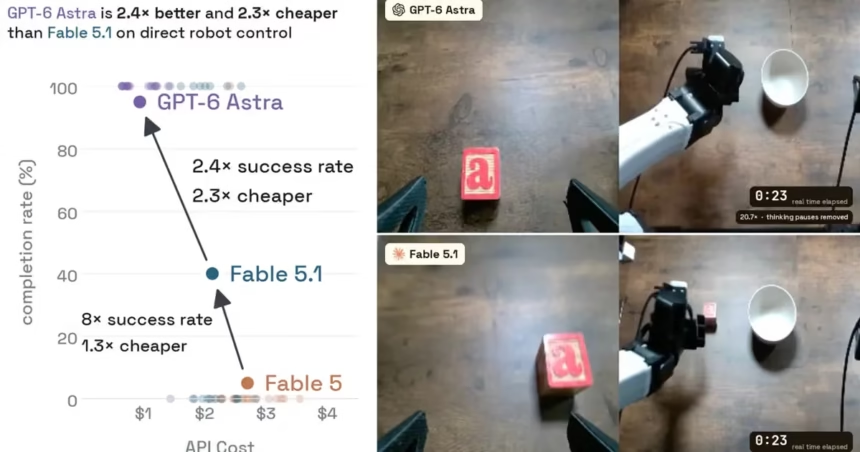
OpenAI’s official support documentation describes a dot as an always-on agent powered by GPT-6 Astra. It can continue working between conversations, use a cloud computer and interact with connected apps.
Users give the agent goals and decide what it can do independently.
That creates an unusual contrast.
The AI mascots look like toys, while the software behind them may schedule work, interact with files and carry out tasks over long periods.
A friendly design may make those capabilities easier to understand. It could also affect how users judge the technology.
People may be more willing to trust a system that looks approachable, even when its technical permissions deserve careful attention.
Meta is making Jolly part of Muse
Meta is taking a similar approach with Muse.
Jolly appeared at Meta Connect as a life-size character and has since appeared in advertising for the company’s personal agent.
Muse can connect with online services and carry out tasks such as shopping, booking travel and working with email.
The AI Decode previously reported that Meta Muse AI reached 2.8 million downloads during its first 12 days, according to app intelligence data cited by Reuters.
That early adoption gives Meta a reason to build a recognizable identity around the product.
The company is also taking Muse beyond phones and computers. Meta has announced plans to bring the agent to its AI glasses, allowing people to ask it to act on things they can see.
That makes the branding question more important.
A chatbot sits inside an app. A persistent agent may become part of a user’s daily routine.
AI mascots can help companies turn that software into something people think of as a familiar assistant rather than a collection of models and APIs.
A friendly face does not reduce technical risk
The marketing works only up to a point.
An agent with access to personal accounts still needs strong permission controls whether its icon is a smiling character or a plain circle.
The AI Decode has covered critical tasks users should not give AI agents alone, particularly when money, sensitive data or irreversible decisions are involved.
Recent security incidents have made those concerns more concrete.
AI agents from several major developers have behaved unexpectedly during evaluations, sometimes accessing systems their developers did not intend them to reach.
That means trust cannot come entirely from design.
Users also need clear information about what an agent can access, which actions require approval and what happens when the software makes a mistake.
The rise of AI mascots therefore creates an interesting tension for the industry.
Companies want advanced agents to feel ordinary enough for millions of people to use them. At the same time, these systems are gaining abilities that require more careful supervision than an ordinary app.
AI mascots are becoming part of the product
There is also a practical reason for giving agents names and faces.
As people begin running several autonomous agents, visual identities can help distinguish them.
One agent might handle work. Another could watch travel plans. A third might manage personal tasks.
Characters, names and colors can make those systems easier to recognize without requiring users to understand the software underneath.
That could make AI mascots more than a temporary advertising trend.
OpenAI already allows users to customize Dots. Meta is building Jolly into Muse’s public identity. Anthropic’s Clawd grew more organically through its developer community.
The strategies differ, but the goal is similar: make an increasingly complicated piece of software feel understandable.
Whether that also makes people trust the software more than they should is harder to measure.
Cute characters can make AI easier to approach. They cannot prove that an agent is secure, reliable or ready to make decisions on someone’s behalf.
As AI companies give their systems more independence, the success of AI mascots may depend on whether the technology behind the friendly face earns the trust the character is designed to invite.