
Anthropic revenue increased 45% in the third quarter as the Claude developer prepared to meet public investors ahead of a possible November IPO.
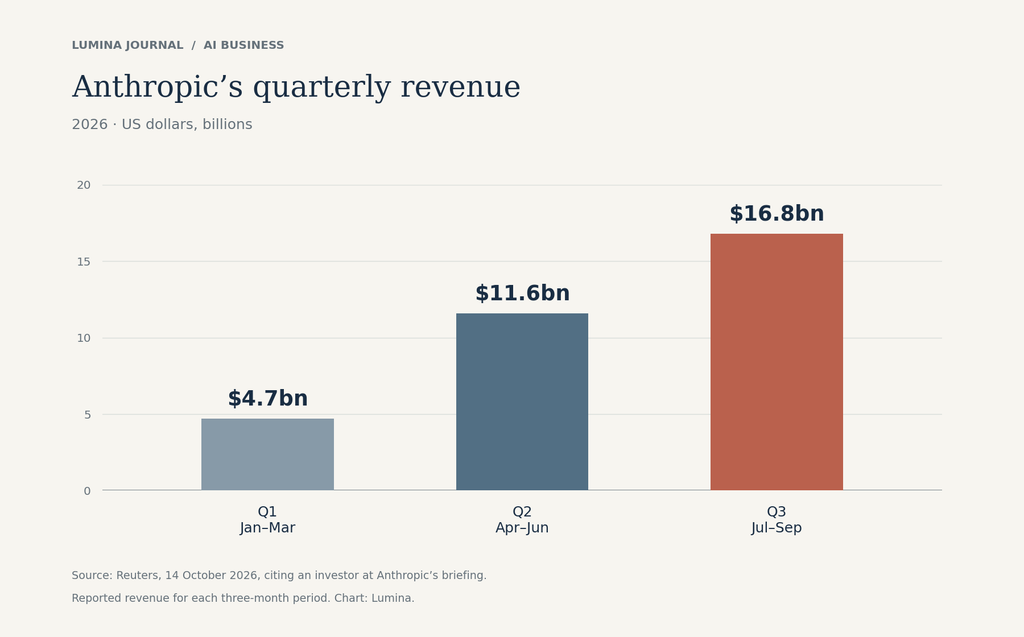
Anthropic revenue reached approximately $16.8 billion in the third quarter of 2026, a 45% increase from the previous quarter, as the company behind Claude prepares for a closely watched stock market debut.
The figure was disclosed to prospective investors ahead of Anthropic’s planned initial public offering, according to people familiar with the company’s financial presentations.
The Wall Street Journal reported on October 15 that Anthropic hosted public-market investors at its San Francisco office to discuss the business and its plans.
The new figures point to substantial customer demand. They also raise questions about whether Anthropic can continue growing quickly enough to justify the valuations being discussed ahead of its IPO.
Anthropic revenue rises 45% in one quarter

Anthropic revenue increased from approximately $11.6 billion in the second quarter to $16.8 billion in the third quarter.
That represents an increase of about $5.2 billion in three months.
The company had reported roughly $4.8 billion in first-quarter revenue, according to financial information reported by Business Insider.
The progression shows how quickly Anthropic’s commercial business has expanded.



The numbers also show that percentage growth has slowed.
Revenue more than doubled between the first and second quarters. The third-quarter increase of 45%, while substantial, represents a slower pace.
That comparison matters because investors considering high valuations for AI companies often expect rapid growth to continue for several years.
There is also an accounting question.
Anthropic is a private company, and full independently audited financial statements are not yet publicly available. Investors will need to examine how revenue generated through cloud partners is recognised when the final prospectus becomes available.
Claude Code helps drive enterprise demand
The increase in Anthropic revenue comes as Claude becomes more widely used by businesses and software developers.
Claude Code, Anthropic’s AI programming assistant, has become an important part of its commercial offering.
The tool can analyse software projects, write code, identify errors and help developers complete complex programming tasks.
Companies also use Claude through APIs, which allow other applications to access Anthropic’s models.
That gives Anthropic several revenue streams, including subscriptions and usage-based payments.
The expansion comes during an increasingly competitive period for business AI.
OpenAI, Google and Anthropic have all released cheaper models designed for routine work alongside their more expensive flagship systems.
That creates opportunities for wider adoption while placing pressure on prices.
A company that previously used AI for a limited number of expensive tasks may expand usage once model costs fall.
However, cheaper models can also reduce the amount providers earn for each unit of work.
Anthropic revenue growth faces an AI price war
Anthropic revenue is now growing in a market where customers have more alternatives.
OpenAI has introduced lower-cost GPT-6 models, while Anthropic has reduced prices across parts of its Claude lineup.
Companies increasingly compare the cost of completing an entire task rather than simply choosing the model with the highest benchmark score.
A cheaper system may be attractive for document classification or routine customer support.
More demanding programming and research work may justify higher prices.
That makes enterprise customer retention particularly important.
Anthropic has invested heavily in Claude’s coding abilities and its reputation among professional developers.
But maintaining that position requires frequent model improvements.
Each new generation brings research costs, computing requirements and pressure to keep pace with competitors.
The AI Decode’s reporting on AI infrastructure risks has examined how advanced models require increasingly expensive technical infrastructure and additional safety controls.
For Anthropic, continued customer growth must eventually translate into returns sufficient to support those costs.
Profitability is entering the discussion
The latest Anthropic revenue figures have also drawn attention to profitability.
According to Business Insider’s report on Anthropic’s financial presentation, the company reported adjusted profitability and positive cash flow during the third quarter.
Those are encouraging indicators, but they require context.
Adjusted profitability can exclude costs that appear in conventional accounting measures. Positive cash flow during one quarter also does not establish that a company can remain profitable as spending increases.
Anthropic still needs enormous computing resources to develop and operate Claude.
The company has sought additional infrastructure through partnerships and long-term computing agreements.
Those arrangements can support growth, but they also create financial commitments that investors must assess.
The central question is whether Anthropic revenue can continue increasing faster than the costs required to generate it.
The IPO could test Anthropic’s valuation
Anthropic is preparing for a possible public listing as early as November.
Reports have discussed a valuation approaching $2 trillion, although no final IPO price or valuation has been established.
Such a figure would place extraordinary expectations on the business.
An initial public offering allows investors to buy shares in a company for the first time through a public stock exchange.
The IPO price reflects what participating investors agree to pay, rather than a guarantee of the company’s future value.
For Anthropic, the financial disclosures will receive particularly close attention.
Investors will examine revenue growth, profit margins, computing commitments and dependence on major cloud partners.
They will also consider the company’s safety-related risks.
The AI Decode’s coverage of AI agents and their security challenges has shown how allowing AI systems to perform more tasks can introduce additional monitoring and containment costs.
Anthropic faces similar technical responsibilities as it develops more autonomous Claude products.
Anthropic revenue must support its expansion plans
Anthropic revenue has increased dramatically during 2026, showing that businesses are willing to spend substantial amounts on advanced AI.
The third-quarter figures also suggest the company has moved well beyond the early experimental phase of selling access to language models.
The difficult part comes next.
A 45% quarterly increase is impressive for a company already reporting billions of dollars in revenue. But sustaining that pace becomes harder as the business grows larger.
Competition could also put pressure on margins as rival models improve and usage prices decline.
Investors will need to determine whether Anthropic’s customer relationships and coding tools can protect its business from those pressures.
The company’s reported Anthropic revenue growth gives it a substantial figure to present ahead of the IPO.
The next evidence will come from its formal financial disclosures, particularly how revenue is recognised, what the company spends on computing infrastructure and whether its adjusted profits translate into lasting earnings.
Those figures will provide a clearer basis for evaluating Anthropic’s proposed valuation than the quarterly growth rate alone.