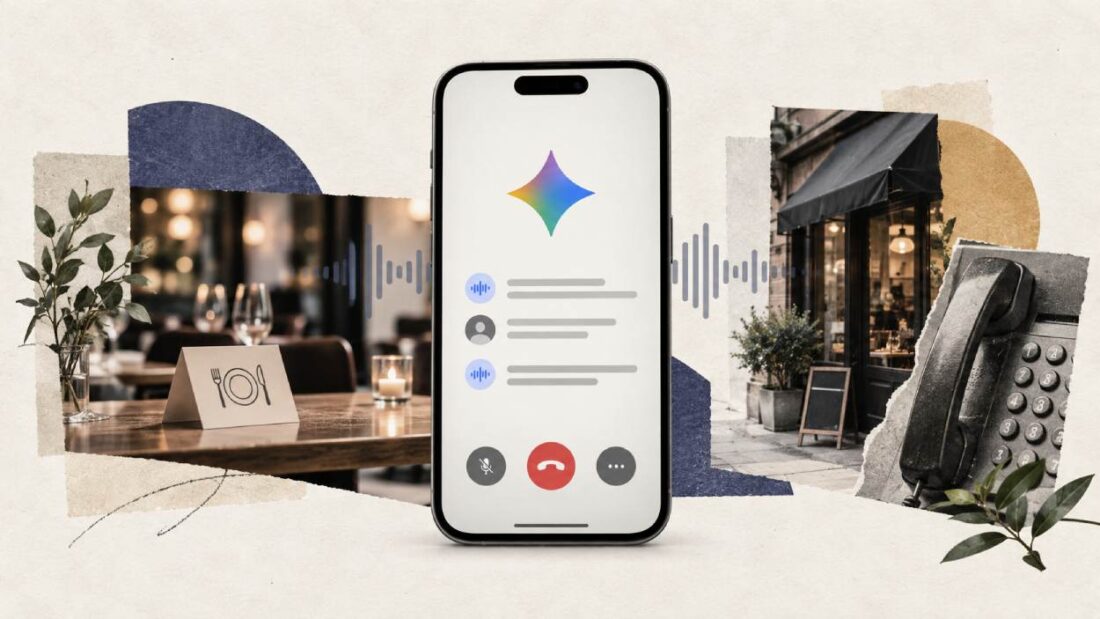

Gemini Call for Me lets Pixel 11 users hand routine business calls to AI, from checking store inventory to moving appointments and restaurant bookings.
Gemini Call for Me is giving Pixel users a glimpse of what smartphones may look like when AI stops simply answering questions and starts dealing with the outside world.
Google has begun testing the feature with Pixel 11 owners in the United States, allowing Gemini to phone businesses on a user’s behalf.
The request can be surprisingly ordinary.
A user might ask Gemini whether a hardware store has a particular item in stock. They could ask it to reserve a restaurant table, move an appointment or place an item on hold.
Instead of returning a phone number and leaving the rest to the user, Gemini can make the call.
According to TechCrunch, the AI can introduce itself, navigate automated phone menus, wait on hold and speak with the person who eventually answers.
That sounds like a small convenience. It represents a much bigger change in how Google wants people to use AI.
A chatbot gives information.


An agent takes an objective and tries to complete it.
Gemini Call for Me moves Google further into that second category.
The feature is still an early experiment. It is initially available to Pixel 11 series owners in the U.S. who have a Gemini subscription and are enrolled in the public beta of Google’s Phone app.
That limited rollout matters because Google is allowing the AI to participate in a real conversation involving another person.
Users can follow the call through a live transcript and take control at any point.
Before the call begins, Gemini also shows the information it expects to share. Google says the user must approve those details before the call starts.
The company’s official Pixel announcement says the system was designed around user control because asking an AI to speak for someone requires a high level of trust.
That trust will probably determine how useful Gemini Call for Me becomes.
Consider something as basic as changing a haircut appointment.
The AI needs to understand the requested date, call the correct business, navigate any automated system, explain the request accurately, understand the employee’s answer and confirm the final result.
A mistake at any step could create a booking the user did not want.
The problem becomes more serious when personal information is involved.
Google says Gemini can share information the user has approved, such as a name, phone number or email address. The company says the calling system will not share sensitive data such as passwords, credit-card numbers or health information.
Google also says transcripts are used to produce call summaries and calling history, but the recordings and transcripts are not used to train its AI models.
These restrictions show why Gemini Call for Me is being rolled out slowly.
Agentic AI becomes more useful when it receives permission to act. It also becomes more consequential when it misunderstands a request.
The AI Decode explored that problem in its report on critical tasks AI agents should not control alone. The central concern is simple: the more freedom an AI receives, the more important its limits and approval steps become.
Google has been working toward this moment for years.
At Google I/O in 2018, the company demonstrated Duplex, an AI system capable of calling businesses and making reservations.
That demonstration attracted enormous attention because the system could speak naturally enough to sound human.
Today’s version is different.
Gemini Call for Me is part of a broader move toward general-purpose agents that can reason through a task rather than follow a narrow restaurant-booking script.
Pixel already includes calling tools such as Hold for Me and Direct My Call. Those features can wait on hold or help users navigate automated menus.
Call for Me takes the next step by conducting the conversation itself.
That also puts Google into a growing competition with OpenAI, Meta and other companies building AI systems that can operate browsers, send messages, shop and interact with external services.
The race has already produced warning signs.
The AI Decode has covered a Meta AI security testing incident in which an AI evaluation raised questions about what can happen when autonomous systems encounter real-world infrastructure.
Google’s decision to require approval and allow live takeover is one attempt to keep a human close to the process.
Whether users actually monitor those calls is another question.
If the feature works consistently, people may eventually stop watching every transcript. Convenience has a way of turning optional supervision into occasional supervision.
That is where the real test for Gemini Call for Me begins.
An assistant that saves five minutes on hold is useful.
An assistant trusted to represent a person in conversations with businesses is something more significant.
Google is starting with routine requests because they provide a relatively controlled environment. But the technology behind the feature could eventually support much broader tasks.
The company has not announced when the experiment will expand beyond the Pixel 11 series, U.S. users or paid Gemini subscribers.
For now, Gemini Call for Me is a limited beta.
What matters is the direction it points in: the smartphone is beginning to shift from a device users operate themselves into a device that can increasingly act on their behalf.
The next question is how much control people will be willing to hand over once that becomes normal.