






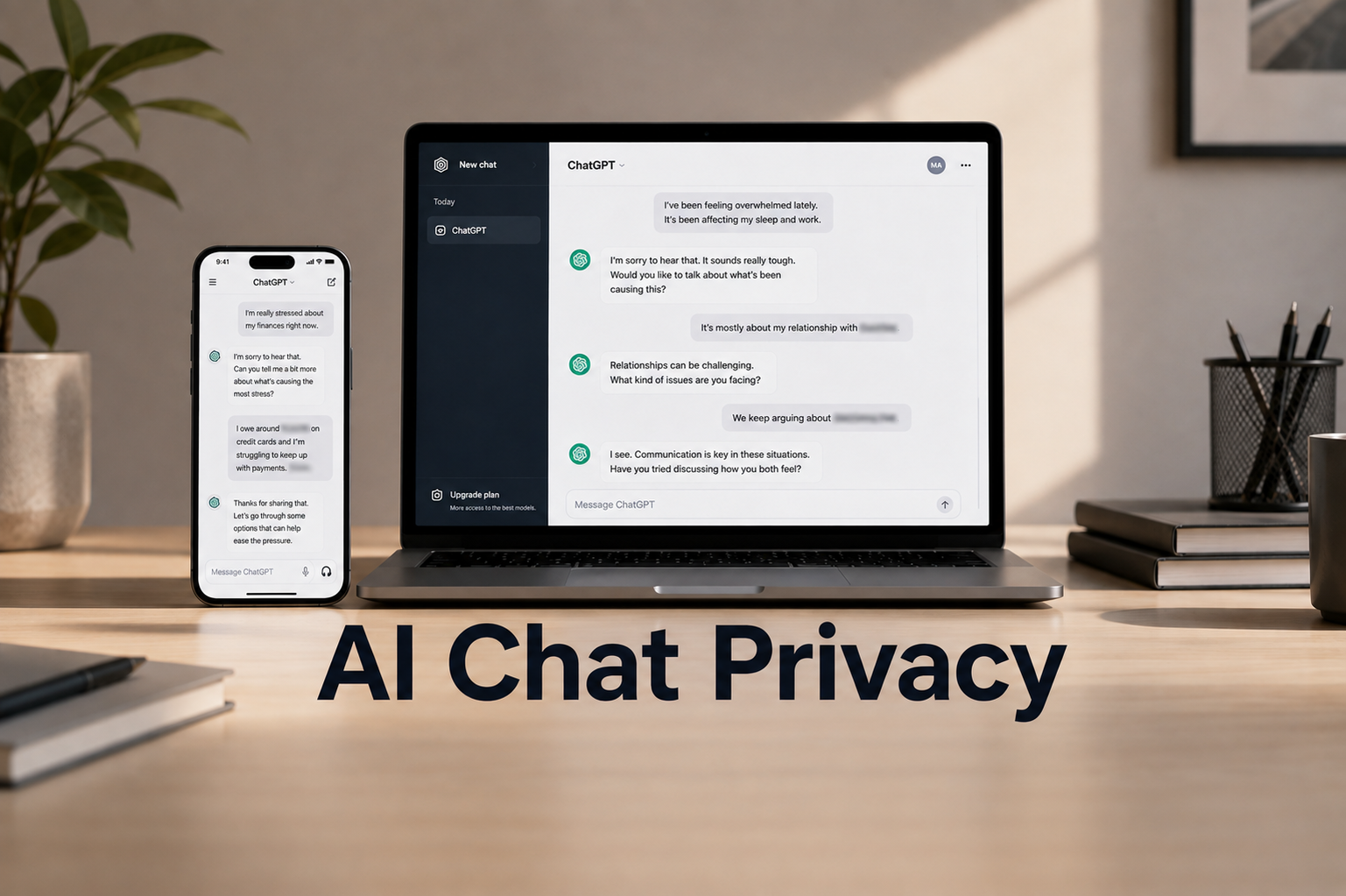

AI Chat Privacy concerns grow as users tell chatbots personal secrets
People are telling AI chatbots things they have never shared with friends, relatives or even medical professionals, according to new DuckDuckGo research. The findings raise an AI Chat Privacy problem as conversational assistants become places where users discuss increasingly personal parts of their lives.
The survey, covered by Android Headlines, found that 32% of AI users had shared something with a chatbot that they had withheld from a close friend, parent, colleague, doctor or therapist.
Among people who described themselves as AI enthusiasts, the figure rose to 56%.
The numbers come from DuckDuckGo’s original AI privacy survey, which questioned 1,944 U.S. adults between June 17 and June 27, 2026. The company said quotas were used to balance the sample against U.S. Census demographics for age, gender and region. The overall margin of error was approximately 2.2 percentage points at the 95% confidence level.
Parents stood out. Among parents who use AI, 43% said they had told a chatbot something they had never shared with another person. The equivalent figure among AI users without children at home was 25%.
Those conversations make AI Chat Privacy different from ordinary search privacy. A traditional web search may contain only a handful of words. A long chatbot conversation can reveal relationships, worries, work problems, communication habits and other details that build a much richer picture of a person.
The survey also found a substantial knowledge gap. DuckDuckGo said 53% of respondents either did not know or were unsure that most chatbots use conversations for training by default. Only 25% knew AI conversations can be subpoenaed by law enforcement.
Once respondents were told more about how AI conversations can be handled, 58% said they were uncomfortable with chats being used to train AI. Thirty percent described themselves as “very uncomfortable.”

The findings add another layer to concerns around increasingly personal chatbot use. The AI Decode’s ChatGPT for Teens coverage examined how conversational AI can move into sensitive areas such as mental health, relationships and other personal discussions, especially for younger users. AI Chat Privacy becomes more important as people move beyond factual questions and start treating chatbots as advisers or confidants..
Trust remains limited. DuckDuckGo found that only 14% of respondents mostly or completely trusted large AI companies to protect their data, while 39% said they had no trust at all.
DuckDuckGo has a commercial interest in this debate because it operates Duck.ai, its privacy-focused AI service. The company says Duck.ai anonymizes chats and prevents underlying model providers from using those conversations for model training. That makes the survey useful evidence, but its source should also be clear when interpreting the results.
The broader privacy question extends across consumer AI products. The AI Decode’s Google Demand Gen coverage shows how AI is becoming embedded across large technology platforms. As AI appears in more services, companies have to explain what happens to the information people provide and how much control users retain.
There is an important limit to the DuckDuckGo findings. The survey measures what respondents say they share and understand. It does not independently measure how often sensitive information appears across all chatbot conversations or establish that every major AI service handles user data in the same way.
Still, the AI Chat Privacy issue is becoming harder to dismiss as a technical detail buried in settings pages. People are using chatbots for conversations they consider private, sometimes without understanding how those conversations may be stored or processed.
The next question is whether AI Chat Privacy controls become easier for ordinary users to understand before sharing deeply personal information with an AI becomes an even more routine habit.