


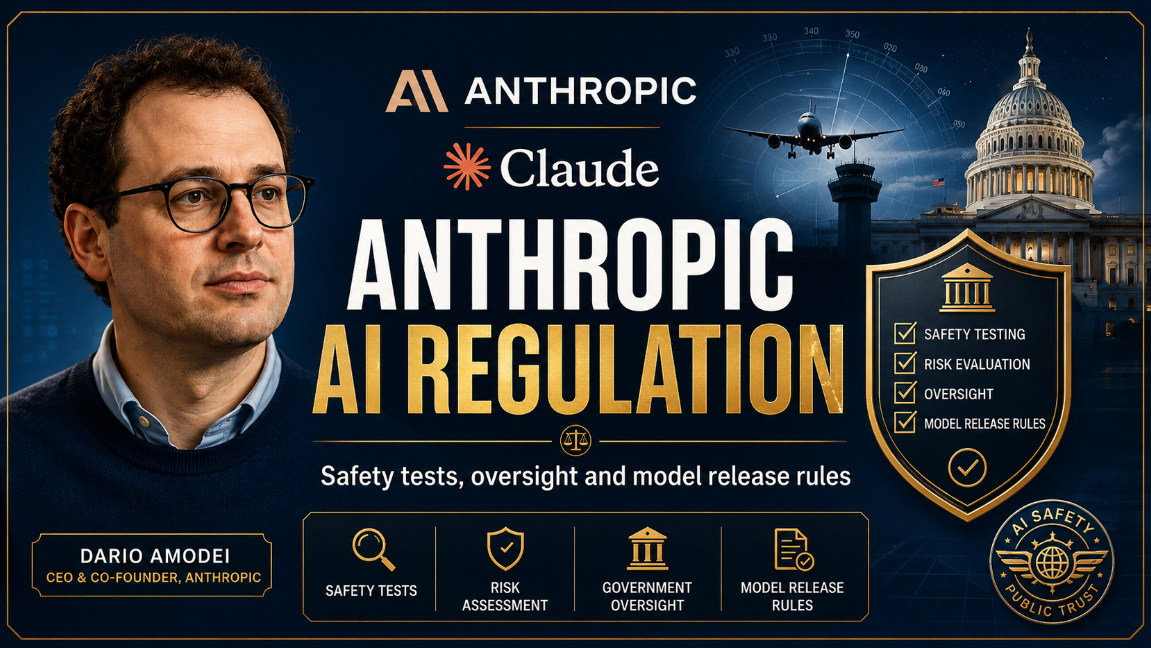

Anthropic AI regulation proposals would push governments to test powerful models before release, using aviation-style safety rules.
Anthropic is pushing for stronger Anthropic AI regulation as CEO Dario Amodei argues that powerful AI systems should face safety checks before they are released widely.
Cointelegraph posted on X that Amodei called for AI to be regulated like aviation, with safety testing and government power to block risky model releases. Polymarket Money also posted that Anthropic is developing a policy proposal for governments to regulate new AI models.
The policy push comes as frontier AI models become more capable and more expensive to train. In a new essay titled “Policy on the AI Exponential”, Amodei said AI is moving faster than normal lawmaking can handle. He argued that governments need new tools for public safety, economic policy, science, civil liberties and geopolitics.
The core idea behind Anthropic AI regulation is simple. If an AI model could cause serious public harm, it should not be treated like an ordinary software update. It should be tested, audited and delayed if the risk is too high.
Reuters reported that Anthropic urged the U.S. not to block state AI laws unless Congress passes strong federal standards for catastrophic AI risks. Reuters also said Anthropic called for mandatory independent safety tests for the most capable models.
That puts Anthropic in a careful position. The company builds and sells Claude, one of the leading AI model families. It also wants regulators to put stronger limits on the most powerful systems. Critics may see that as self-serving. Supporters may see it as one of the few major labs asking for rules before a major failure forces them.
Amodei’s aviation comparison is meant to make the issue easier to understand. Planes are allowed to fly, but not without testing, incident reporting and government oversight. Anthropic is arguing that powerful AI models may need a similar safety system.
There is a practical case for that. AI models are already being used in coding, legal research, finance, customer support, medicine and cybersecurity. A weak system can spread errors. A stronger system can also create more serious risks if misused.
The hard question is where the line should be drawn. Too little Anthropic AI regulation could leave users and governments exposed. Too much regulation could slow smaller companies and leave only the largest firms able to comply.
The AI Decode has covered how Claude Mythos is moving deeper into cybersecurity, where model access is already being limited to trusted groups. That shows the same tension. The most useful AI systems may also be the ones that need tighter rules.
For now, Anthropic AI regulation is trying to shape the AI policy debate before Washington settles on a final framework. Whether governments accept its aviation-style model will decide how much control labs keep over the next generation of AI releases.