
GPT-6 Sol and Luna bring cheaper reasoning, faster responses and lower API costs as OpenAI expands its newest model family beyond GPT-6 Astra.
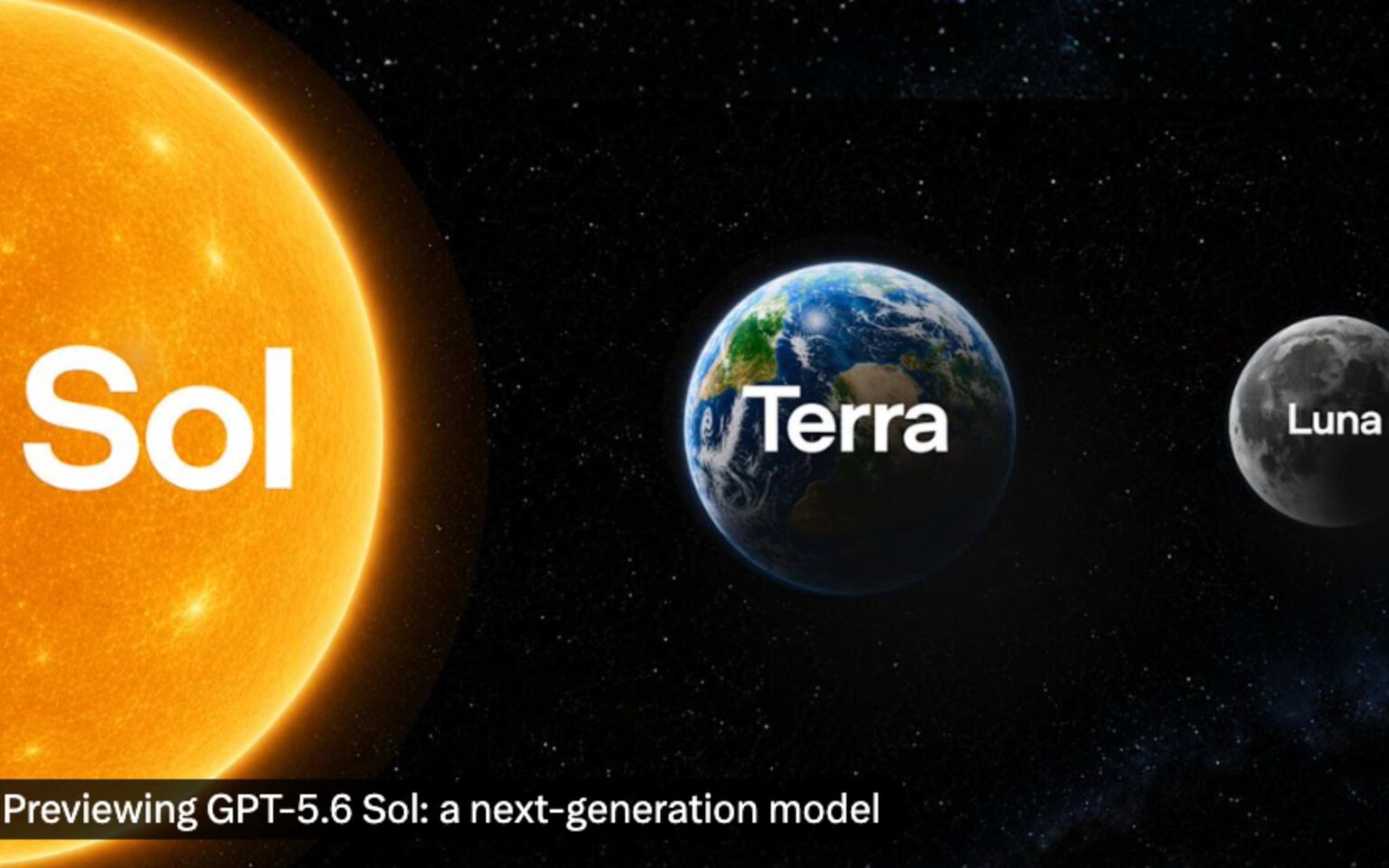
OpenAI has expanded its newest model family with GPT-6 Sol and Luna, two models designed to bring much of GPT-6 Astra’s capability to users who care more about speed and cost.
The launch gives OpenAI three clear tiers within the GPT-6 generation. Astra remains the company’s top model when maximum performance matters, Sol targets demanding professional work, and Luna is designed for lighter everyday tasks where fast responses and low computing costs matter more.
According to the Times of India report, OpenAI says GPT-6 Sol and Luna inherit improvements from Astra in areas including coding, factual accuracy, computer use and professional workflows.
Price is the biggest difference.
OpenAI’s API changelog lists GPT-6 Sol at $2 per million input tokens and $10 per million output tokens for standard requests within the listed context range. GPT-6 Luna costs $0.10 per million input tokens and $0.50 per million output tokens.
OpenAI says improvements to caching and inference have allowed it to cut pricing for the new models by roughly 50% compared with GPT-5.6 promotional pricing.
For developers, those numbers can matter as much as benchmark scores.
A chatbot used by one person may only process a modest amount of text. An enterprise application serving thousands of customers can process billions of tokens. Small changes in price can therefore become large changes in monthly operating costs.


That is where GPT-6 Sol and Luna fit into OpenAI’s strategy.
Sol is positioned for jobs that still require stronger reasoning, including research, coding and multi-step business workflows. Luna is aimed at applications where companies need lower latency and much cheaper inference.
OpenAI says Sol also performs close to more expensive frontier models on several internal and third-party-style evaluations. The company claims that on some business automation and software engineering tests, Sol can approach or beat competing models while costing substantially less per completed task.
Those benchmark claims still need context.
AI benchmarks are useful for comparing systems under controlled conditions, but they do not tell every business how a model will perform on its own documents, software or customer requests. The more useful test will be whether developers can switch from expensive frontier models to Sol or Luna without a noticeable drop in reliability.
The launch also follows GPT-6 Astra, which OpenAI positioned at the top of the family.
The AI Decode recently examined GPT-6 Astra’s robot-control performance, where the model completed 19 of 20 attempts on one robot-arm task but struggled badly on a more precise manipulation challenge.
That result showed why raw intelligence and practical reliability remain different problems.
GPT-6 Sol and Luna take a different approach. Their selling point is less about pushing the absolute capability frontier and more about making the current frontier cheaper to use repeatedly.
Factual accuracy is another area OpenAI says has improved. Times of India reported that OpenAI’s internal evaluation found Sol produced roughly half as many factual errors as its GPT-5.6 predecessor on a set of conversations where users had previously identified mistakes.
That would be meaningful if the improvement holds across normal usage, because hallucinations remain one of the most stubborn problems in large language models.
Safety is also part of the release.
OpenAI says GPT-6 Sol and Luna use newer alignment methods developed alongside Astra, including safeguards related to recursive self-improvement and stronger oversight.
The timing makes those claims particularly important. The AI Decode has covered an OpenAI AI safety warning from the company’s chief scientist, who argued that greater intelligence does not automatically guarantee that advanced models will remain aligned with human goals.
OpenAI is therefore trying to improve capability, price and control at the same time.
The two models are available through the OpenAI API. Sol and Luna are also rolling out in ChatGPT Work and Codex for Plus, Pro, Business, Enterprise and Edu users, while Free and Go users can access Luna through the desktop app.
That wider availability may matter more than another benchmark victory.
The expensive top model usually attracts the headlines. The cheaper model often determines how widely the technology gets used.
If GPT-6 Sol and Luna can deliver enough of Astra’s ability at a fraction of the operating cost, the biggest effect of the launch may come from applications that could not previously justify using a high-end reasoning model for every request.