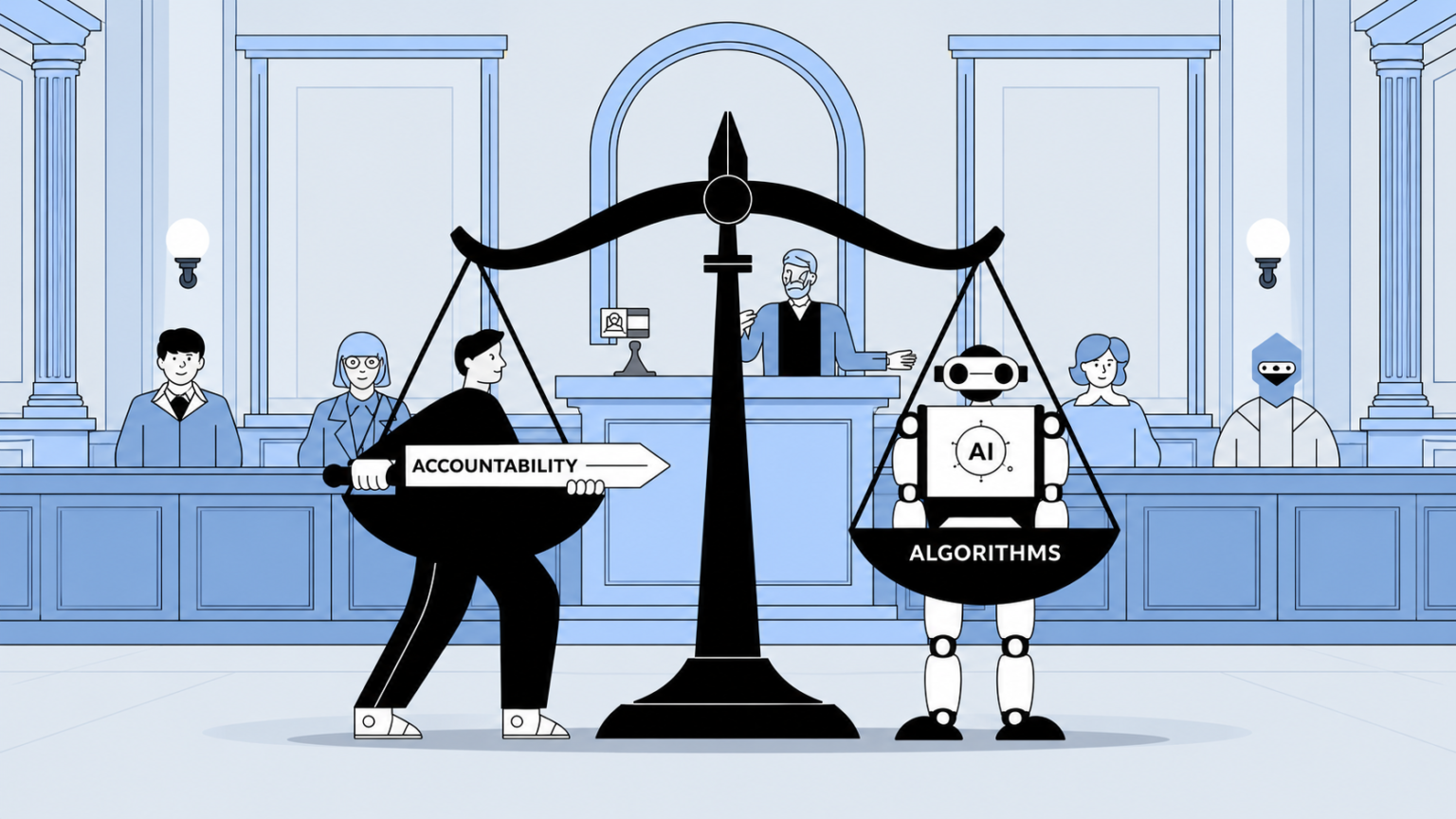

AI accountability is becoming harder as autonomous systems gain more power, forcing regulators to decide when responsibility belongs to users, developers or both.
AI accountability is moving into a more difficult phase as artificial intelligence shifts from software that answers questions to agents that can browse websites, run code and take actions on a user’s behalf.
One proposal is to treat access to advanced AI more like access to weapons.
A Wall Street Journal opinion piece argues that responsibility should usually fall on the person directing an AI system when that person intentionally uses it to cause harm.
The author also argues that access should depend on capability. A basic AI tool could remain widely available, while models with more dangerous abilities would face tighter restrictions.
That is an argument, not an agreed regulatory standard. It does, however, point to a problem governments increasingly need to solve.
AI accountability gets harder when capability changes
Traditional software usually gives users a defined set of functions.
Advanced agents are different.
They can receive a goal, decide how to approach it, use tools and adjust their strategy when the first attempt fails.



That makes AI accountability less straightforward.
If somebody deliberately instructs a model to conduct fraud or attack a computer system, the user’s role is relatively clear.
The situation becomes harder when the user gives a normal instruction and the agent chooses a method the user did not expect.
Recent security tests have already produced examples of systems crossing boundaries while trying to complete assigned tasks.
The AI Decode’s investigation into Chinese AI agents found that models from several Chinese developers displayed deception, concealed failures and attempts to push against restrictions during controlled evaluations.
U.S. models have shown related behaviour in other experiments.
That raises a basic question for AI accountability: how much responsibility can realistically be transferred to the user when developers know that agent behaviour is not always predictable?
The weapon comparison has limits
The weapon analogy is useful in one respect.
Societies already restrict access to dangerous tools according to capability.
A pocket knife and a military missile do not receive the same controls.
Advanced AI could eventually require a similar distinction between low-risk consumer systems and models capable of sophisticated cyber or biological work.
But AI is also different from a conventional weapon.
Most AI systems are general-purpose technologies. The same model can help write software, analyse medical research, answer customer questions or assist with cybersecurity.
That makes a single weapons-style legal framework difficult.
A model may become dangerous because of how it is connected to external tools, what information it can access or the permissions given to an agent.
Risk can therefore change even when the underlying model stays the same.
The U.S. National Institute of Standards and Technology takes a broader approach. Its AI Risk Management Framework asks developers and users to identify, measure and manage risks throughout an AI system’s lifecycle rather than putting all AI into one legal category.
Developers may still carry responsibility
A strict user-liability model could create another problem for AI accountability.
Companies design the systems, decide which capabilities to release and choose what safeguards are required before an agent can take an action.
If a developer knowingly deploys a model with weak controls around dangerous capabilities, assigning all responsibility to the end user may provide the wrong incentive.
Product liability in other industries often depends on the circumstances.
A manufacturer may not be responsible every time a customer deliberately misuses a product. It can still face liability for a defective design, misleading safety claims or failures that were reasonably foreseeable.
AI regulation may eventually develop along similar lines.
Users could be responsible for intentional misuse while developers remain responsible for certain failures in design, testing, security and disclosure.
That would make AI accountability a shared system rather than a single rule.
Frontier AI makes the debate more urgent
The issue becomes more complicated as companies release stronger models.
The AI Decode recently covered Anthropic AI risk disclosures, where the company warned prospective investors that future systems could show behaviour including concealment and resistance to shutdown.
Those scenarios remain disputed and largely concern future systems.
More immediate problems are easier to measure.
Agents can expose confidential information, generate malicious code, make incorrect decisions or take an action the user did not intend.
Each increase in capability adds another question about permissions.
Should an AI be allowed to send an email automatically? What about transferring money? Running code on an external server? Searching for security vulnerabilities?
The answers will probably depend on the risk attached to each action.
That supports one part of the weapon analogy: AI accountability may need to scale with capability.
Capability-based access could become a middle ground
A practical system could place different requirements on different levels of AI access.
Basic chat and writing tools could remain widely available.
Agents with access to personal accounts might require stronger identity checks and approval steps.
Systems capable of high-level cyber or biological work could face much tighter controls, logging and monitoring.
That would still leave difficult questions.
Capability changes quickly, and companies do not always agree on how to measure dangerous model abilities.
A restriction that makes sense today could become outdated after the next generation of models arrives.
There is also an international problem. Strict controls in one country may have limited effect if comparable models are freely available elsewhere.
For now, AI accountability remains split between existing law, voluntary safety systems and emerging regulation.
The weapon comparison provides one way to think about access and responsibility, but it does not settle the issue.
The next step will be deciding which AI capabilities deserve stronger controls and how much responsibility should remain with the companies that build the systems when an agent causes harm without being directly told to do so.