





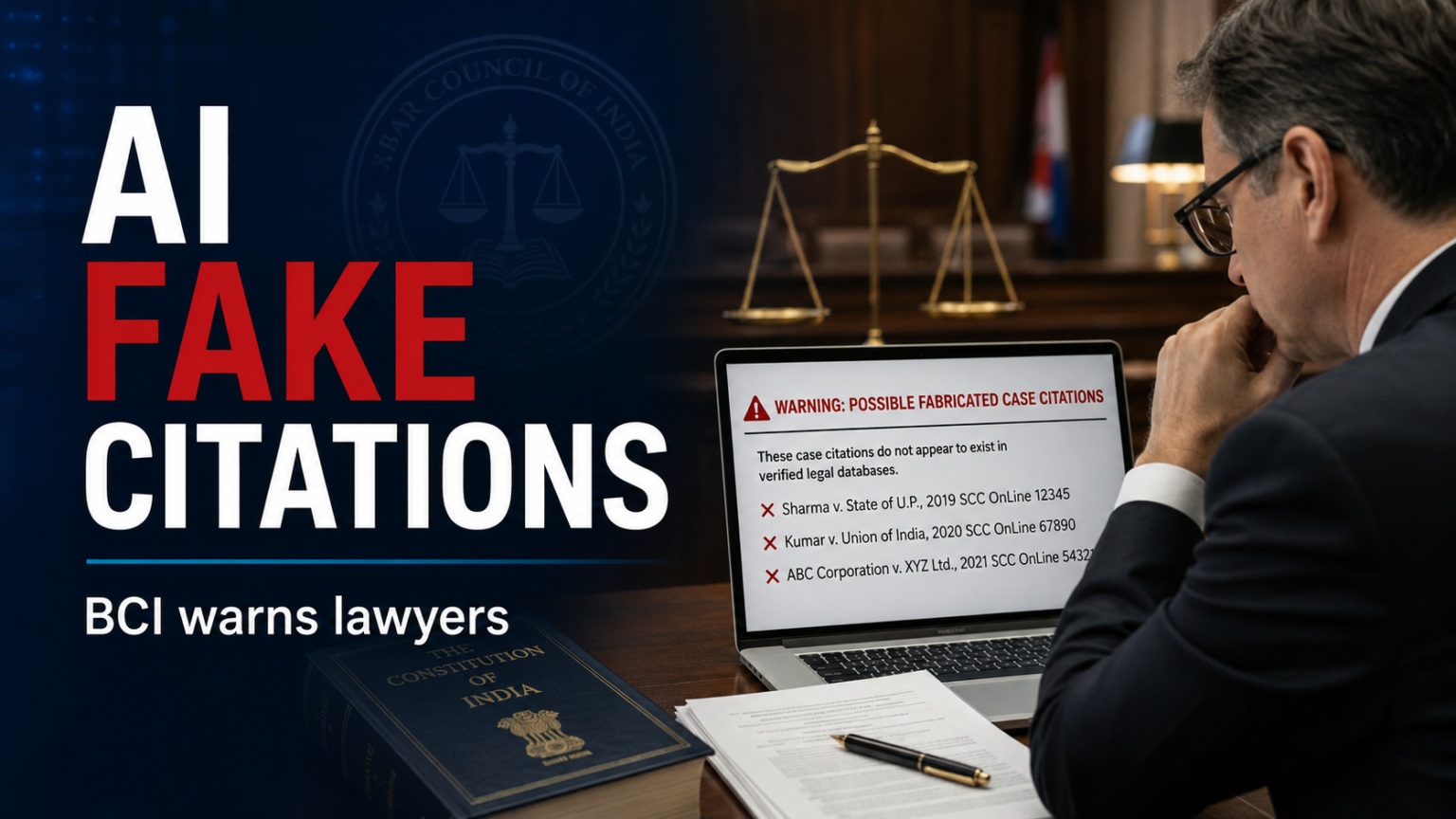

The Bar Council of India says advocates must verify AI-generated legal research and cannot blame technology for AI fake citations or fabricated quotes.
The Bar Council of India has warned that lawyers can face professional consequences for AI fake citations, making clear that advocates cannot shift blame to software when false cases, fake quotations or non-existent judgments enter court filings.
The BCI told Parliament that lawyers remain responsible for every pleading and submission filed before a court, even when artificial intelligence is used for research or drafting. The Council said an advocate cannot avoid accountability by saying that a machine produced the error, since the machine does not sign pleadings or owe duties to the court.
The position does not ban AI in legal practice. The BCI said lawyers may use AI tools for preliminary research, drafting help, summarisation, transcription, document organisation and identifying drafting errors. But it added that every statute, precedent, quotation and legal proposition generated by AI must be checked from authoritative sources before being used in court.
The warning comes as courts in India and abroad face rising concern over AI fake citations. The BCI referred to Supreme Court concerns over petitions containing fabricated citations and fake legal quotations generated through AI tools. It also cited the Supreme Court’s order in Gummadi Usha Rani v Sure Mallikarjuna Rao, where the Court took note of allegations that a trial court had relied on AI-generated non-existent judgments.
The risk is not only about embarrassment. The BCI said irresponsible use of AI that leads to false authorities, misleading submissions, breach of confidentiality or negligent pleadings may invite disciplinary proceedings under Sections 35 and 36 of the Advocates Act, 1961.
There is a practical side to the issue. Lawyers are under pressure to work faster, and AI tools can help with first drafts and search. But AI fake citations show why legal work cannot be treated like ordinary content generation. A wrong case name can waste court time, damage a client’s case and affect trust in the judicial process.
Reuters reported a similar problem in the United States, where two lawyers were sanctioned by an appeals court on June 3, 2026 over fictitious AI-generated case citations and lack of candor. That case shows the same message moving across jurisdictions: AI use may be allowed, but unchecked AI use is becoming a discipline issue.
The AI Decode has covered how AI coding tools pose serious risks for developers. The legal version is sharper. In court, AI fake citations or a hallucinated answer is not just a bad output. It can become evidence of professional misconduct.