




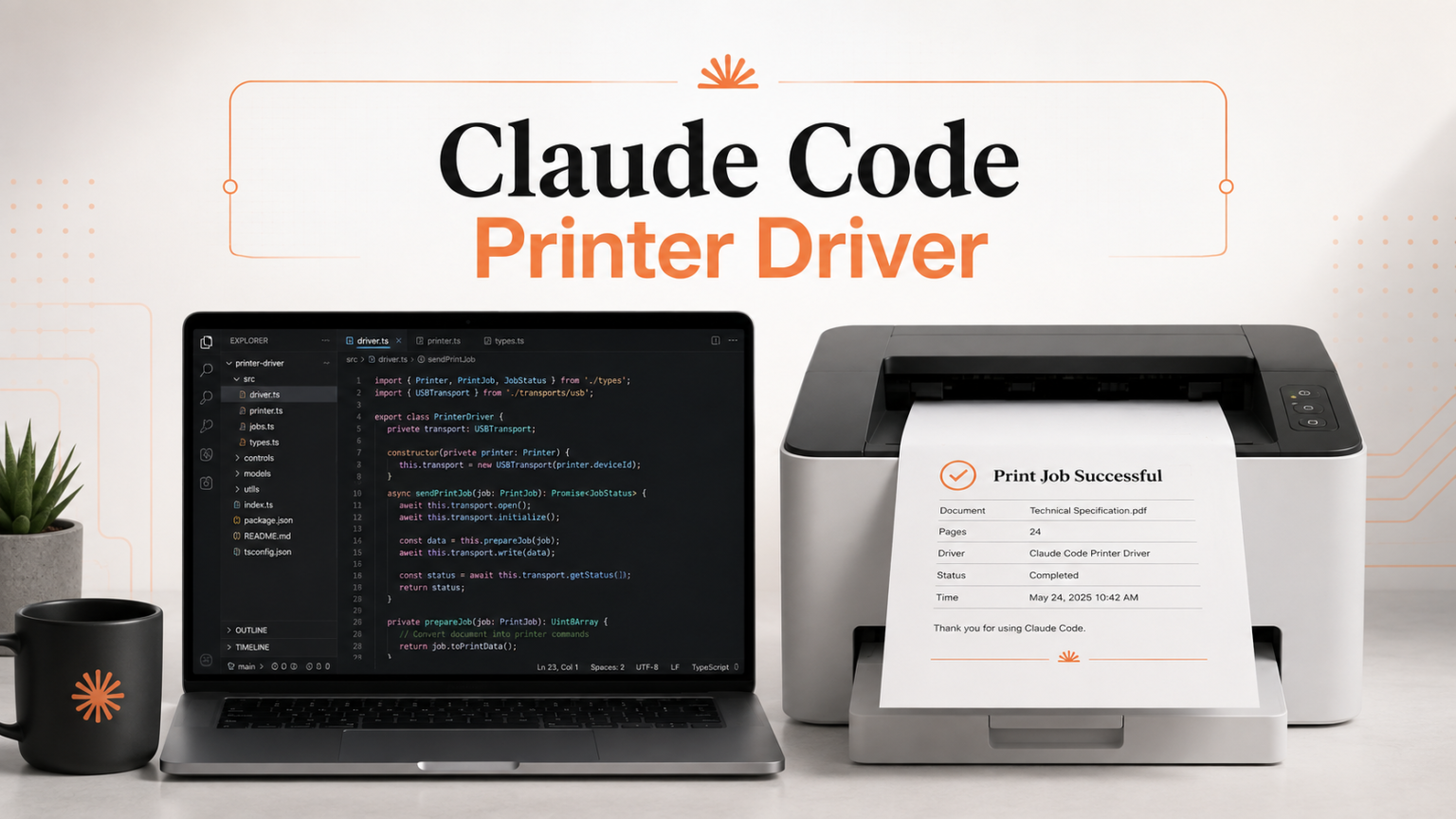

Claude Code Printer Driver shows where AI coding can solve neglected hardware problems
An India-based developer has used Anthropic’s coding agent to build macOS support for an obscure HP laser printer that officially supported Windows and Linux. The Claude Code Printer Driver project is a useful example of AI coding applied to a problem too small for most hardware companies to prioritize.
Developer Kuber Mehta created the tool for the HP Laser 1008a, according to TechRadar. The printer was released in 2023 but did not have an official macOS driver or AirPrint support.
The technical problem was more complicated than simply translating an existing driver. Mehta described the printer as a rebadged Samsung host-based model that communicates using a proprietary raster language called SPL3.
The HP Laser 1008a and related models also do not support the common PostScript or PCL printer languages. That left the Claude Code Printer Driver project without an existing macOS SPL3 driver to modify directly.
Mehta instead used the Windows and Linux software as references while working with Claude Code. TechRadar reports that he used the Opus 4.8 model and reached a working driver in roughly 30 to 40 prompts.
The process was not automatic. Claude made assertions that Mehta had to correct. The pair also had to work out how the printer communicated by examining error pages and interacting directly with the hardware.
At one stage, the project ran HP’s raster-to-SPL codec inside a Linux container to generate genuine SPL3 output. The finished approach patches SpliX, an open-source macOS printer driver package, to support the SPL3 devices.
The resulting software was released under the MIT licence. Mehta later simplified it into a small native IOKit helper that no longer depends on Python, pyusb or libusb.



The Claude Code Printer Driver is interesting because it tackles a common weakness in old and niche hardware: software support often disappears before the physical device stops working.
Anthropic describes Claude Code as an agentic coding tool that can inspect projects, modify files and execute commands. The AI Decode’s report on AI loops and Claude Code examined how coding agents are moving beyond one-off code generation toward longer development workflows.
There are still limits. Mehta was already a developer, checked Claude’s claims and worked directly with the printer while debugging the software. The result does not show that a nontechnical user can ask an AI for any missing hardware driver and safely install whatever it produces.
That distinction also appears in The AI Decode’s AI agents guide, which notes that Claude Code can handle complex software projects but still benefits from human oversight.
The Claude Code Printer Driver project nevertheless gives AI coding a practical test outside standard web and app development. Instead of generating another prototype, the agent helped reverse engineer enough of an unsupported device to make it work on another operating system.
The next question is whether projects like this remain clever one-offs or become a normal way for developers to keep unsupported hardware working.