








ChatGPT for Teens adds new safeguards for younger users, but privacy, homework, emotional reliance and screen habits still need attention.
OpenAI launched ChatGPT for Teens on August 18, putting a new version of ChatGPT in front of users ages 13 to 17.
For parents, the headline feature is protection. ChatGPT for Teens adds stronger limits around sensitive subjects, age prediction, study tools and optional parental controls.
According to Reuters’ report on the launch, OpenAI automatically places users into the teen experience when its systems determine they are under 18. The launch comes as AI companies face growing questions about teenagers using chatbots for schoolwork, personal advice and emotional support.
The safeguards are useful. They also make it easy to assume the problem has been solved.
It has not.
Here are nine ChatGPT for Teens risks families should understand.
1. Age prediction can get it wrong
ChatGPT for Teens partly relies on information about a user’s age and automated estimates.
That means the system has to decide who looks like a teenager.



OpenAI says an account may receive teen protections when its systems believe the user is under 18, even when other account information suggests otherwise.
Adults who are placed into the teen experience incorrectly can use age verification.
For families, the lesson is simple. Age prediction is another safety layer. It is not a perfect identity check.
Parents should still know which account their teenager uses and whether the teen protections are active.
2. Parental controls do not show every chat
Parents should understand this one before linking accounts.
OpenAI says parental controls do not let parents read a teenager’s ChatGPT conversations or monitor them in real time.
Linked parents can manage selected settings, schedule Quiet Hours and receive certain safety notifications.
OpenAI explains those limits in its current parental control guidance. The company says safety notifications are reserved for limited situations, including certain serious self-harm or violence concerns.
That approach protects a teenager’s privacy.
It also means parental controls should not be mistaken for a live monitoring system.
3. A chatbot can feel more understanding than it is
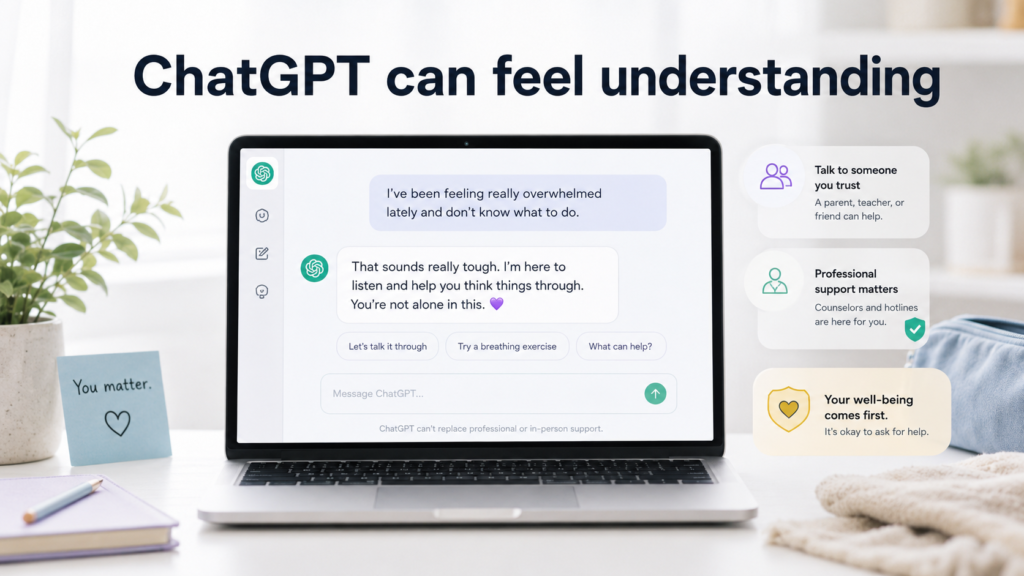
ChatGPT replies quickly. It does not get tired of questions. It can keep talking for hours.
For a teenager who feels embarrassed, lonely or stressed, that can make ChatGPT for Teens unusually easy to talk to.
The risk comes when helpful conversation starts carrying the authority of a close friend, counsellor or expert.
OpenAI has added stronger rules for sensitive conversations, while Reuters reported that emotional dependence is one of the concerns surrounding teen chatbot use.
Serious emotional, medical and safety problems still belong with trusted adults and qualified professionals.
4. Homework help can quietly become homework replacement
This may be the most ordinary ChatGPT for Teens problem.
A student gets stuck on an essay.
Instead of asking for an explanation, they ask for the entire essay.
A maths problem becomes a copied answer. A coding assignment becomes generated code the student barely understands.
OpenAI says the teen experience is designed to support learning rather than simply hand over answers.
The AI Decode has already examined how AI student learning can create dependence when students skip the difficult part of solving problems themselves.
A better habit is attempt first, ask for help second.
5. Safety filters are still filters
No safety system catches every possible conversation.
OpenAI itself has previously said guardrails are not foolproof and that determined users may try to work around them.
ChatGPT for Teens answers more cautiously around topics such as self-harm, violence and age-inappropriate material.
That should reduce risk.
It should not convince families that a general-purpose chatbot has suddenly become a closed children’s app.
Teenagers are also very good at discovering workarounds shared by other users online.
Safeguards work better when family rules exist alongside them.
6. Memory can make the relationship feel more personal
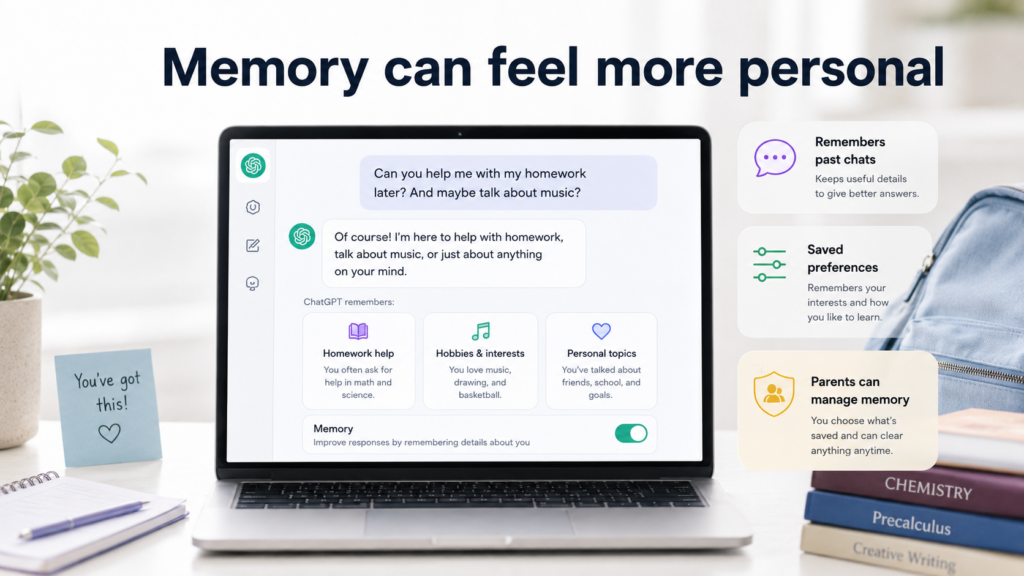
A chatbot becomes more convenient when it remembers you.
It can recall interests, preferences and previous discussions instead of starting from zero every time.
That convenience can also make ChatGPT for Teens feel more personal than a normal search tool.
OpenAI allows linked parents to manage some memory settings.
Families should make that decision deliberately.
A teenager may use the same account for homework, hobbies and deeply personal questions. Parents should understand what information is being remembered before leaving that setting untouched.
7. Voice makes the chatbot feel different
Typing creates a little distance.
Talking does not.
A responsive voice can make a chatbot interaction feel closer to speaking with another person.
That can be useful for practising languages or asking questions without typing. It can also increase the feeling that the system understands the user personally.
Parents can manage some features through linked controls.
The concern is less about voice technology itself and more about how much authority a young user starts giving ChatGPT for Teens because the interaction feels natural.
8. A safety notification does not mean constant protection
Parents who receive safety alerts may assume the system is watching every difficult conversation.
OpenAI says it is not.
Parents cannot read chat history through the parental control system, and alerts are intended for specific serious situations.
That distinction matters.
A teenager can still have confusing, unhealthy or deeply personal conversations that never produce a parental alert.
The AI Decode has also covered the wider ChatGPT safety and child-protection fight, which shows why responsibility for younger users has become a legal as well as technical issue.
9. ChatGPT cannot decide what healthy use looks like for your family
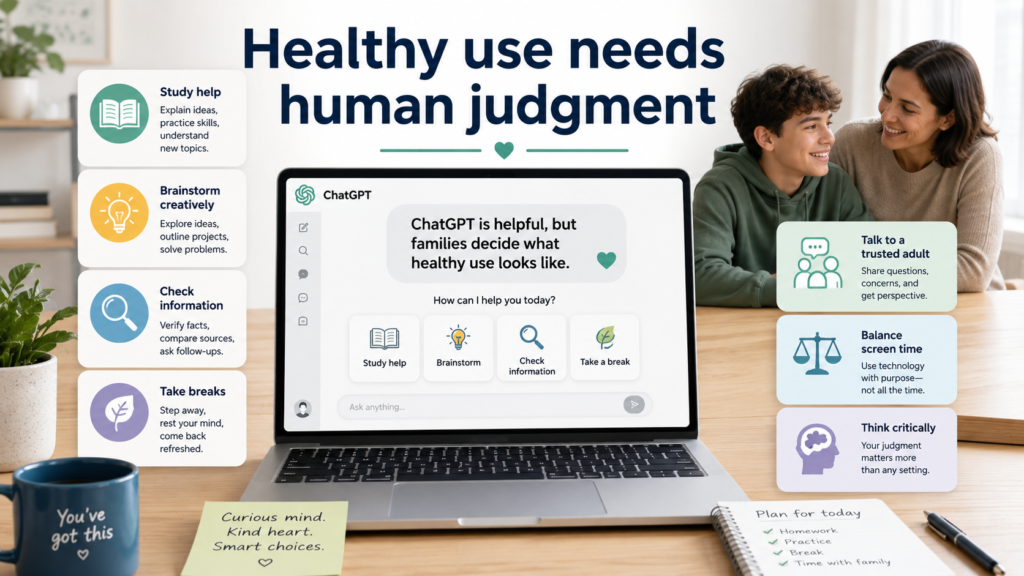
This is the hardest ChatGPT for Teens risk to solve with a settings page.
One teenager may use ChatGPT for 20 minutes to understand algebra.
Another may spend hours using it to avoid homework, social problems or difficult decisions.
Software cannot fully understand that difference.
Parents do not need to read every conversation. They do need to know how AI fits into their child’s day.
Ask what they use it for. Discuss when information should be checked. Make it normal to question a confident answer.
ChatGPT for Teens can be useful for explanations, brainstorming, study practice and curiosity.
The new protections give families more tools than they had before.
They still leave one job firmly with humans: deciding when a teenager needs a chatbot and when they need another person.