



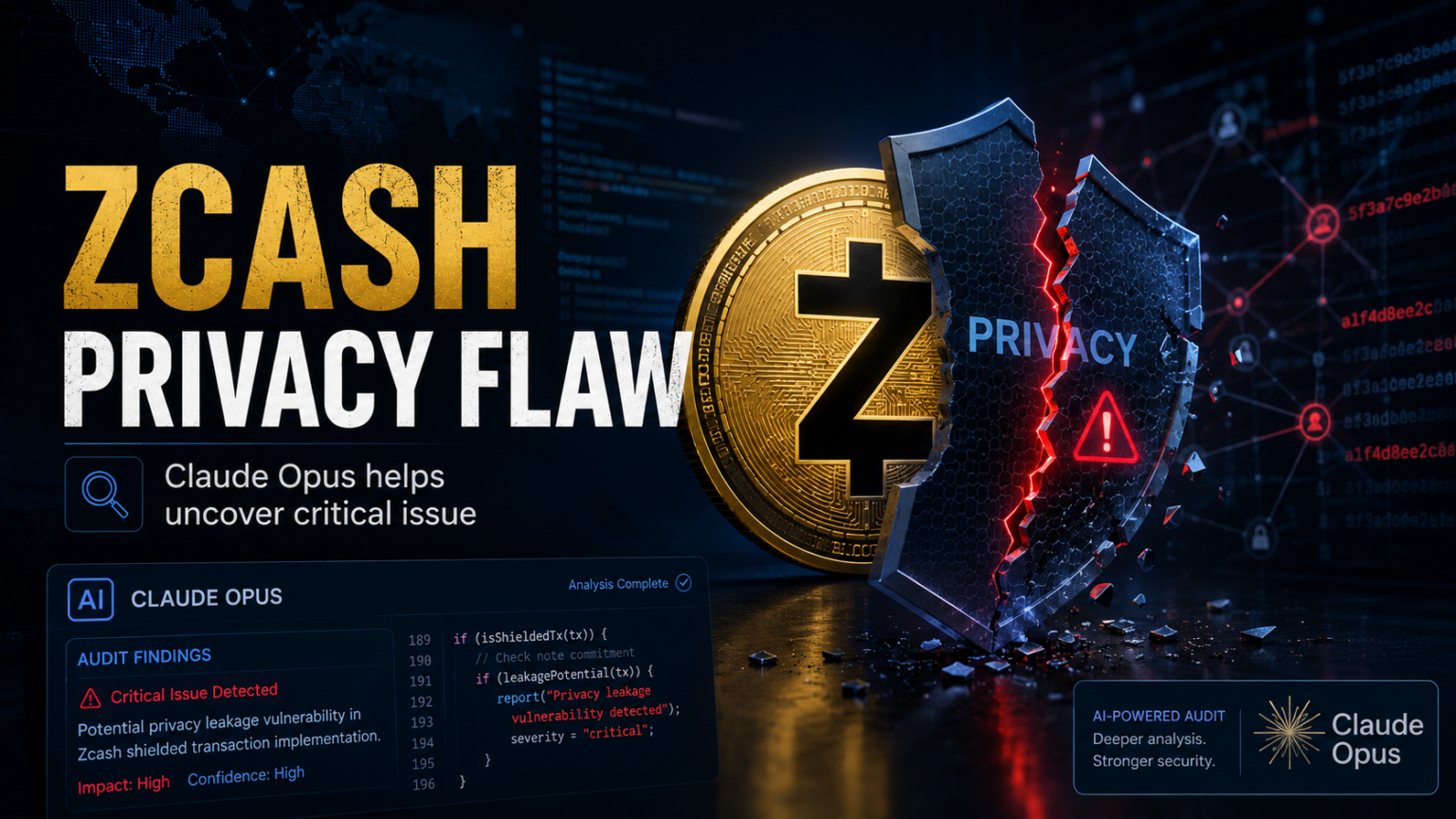

The Zcash privacy flaw found with Claude Opus 4.8 could have allowed counterfeit ZEC, while privacy rules make past misuse hard to prove.
A Zcash privacy flaw found with Anthropic’s Claude Opus 4.8 has raised a difficult question for privacy coins: what happens when a bug can be fixed, but past misuse cannot be fully ruled out?
Zcash, also called ZEC, is a cryptocurrency built for people who want more privacy than Bitcoin usually gives. On Bitcoin, most transaction details can be seen on the public blockchain. Zcash is different because it gives users the option to hide key details such as the sender, receiver and amount. Its official site describes Zcash as “encrypted electronic cash,” while Zcash documentation says it uses advanced cryptography and shielded addresses to protect financial privacy.
That privacy feature is the reason this case matters. A normal blockchain is easier to audit because the money trail is public. Zcash’s private system is designed to hide that trail. That is good for user privacy, but it can make some security problems harder to check after the fact.
Security Affairs reported that security researcher Taylor Hornby used Claude Opus 4.8 to find a critical vulnerability in Zcash’s Orchard privacy pool. The flaw could have allowed counterfeit ZEC to be created inside the shielded pool.
The strongest source came from the Zcash community itself. In a post on the Zcash Community Forum, Zooko Wilcox, Jason McGee and Taylor Hornby said Hornby discovered the vulnerability on May 29, 2026, and disclosed it to Zcash Open Development Lab. The emergency response was completed in early June.
The Zcash privacy flaw was serious because Orchard is designed to protect transaction privacy. That same privacy makes the forensic problem harder. The forum post said there is no definitive way, using only cryptography, to prove whether the vulnerability was exploited before it was fixed.
CoinDesk reported that ZEC fell 38% after the disclosure. CoinDesk said the bug had been present since Orchard’s activation in May 2022 and was patched after an emergency fix by June 1, 2026.
Shielded Labs said exploitation was unlikely, but it also said users should not rely only on that assessment. The proposed next step is a network upgrade using a new shielded pool and turnstile accounting, so the Zcash supply can be checked more clearly.


The case is important beyond Zcash. A public AI model helped a skilled researcher find a four-year-old flaw in a heavily reviewed cryptographic system. That makes Zcash privacy flaw coverage relevant to every crypto project that depends on complex proofs, privacy layers or zero-knowledge systems.
There is a positive side. AI-assisted audits may help researchers find bugs before attackers do. There is also a harder side. If defenders can use stronger AI models, attackers can try the same.
The AI Decode has covered how AI coding tools pose serious risks for developers. The Zcash case shows the higher-stakes version of that problem. In crypto, a code error can become a market event.
For now, the Zcash privacy flaw is fixed. The harder task is rebuilding confidence in what happened before the fix.