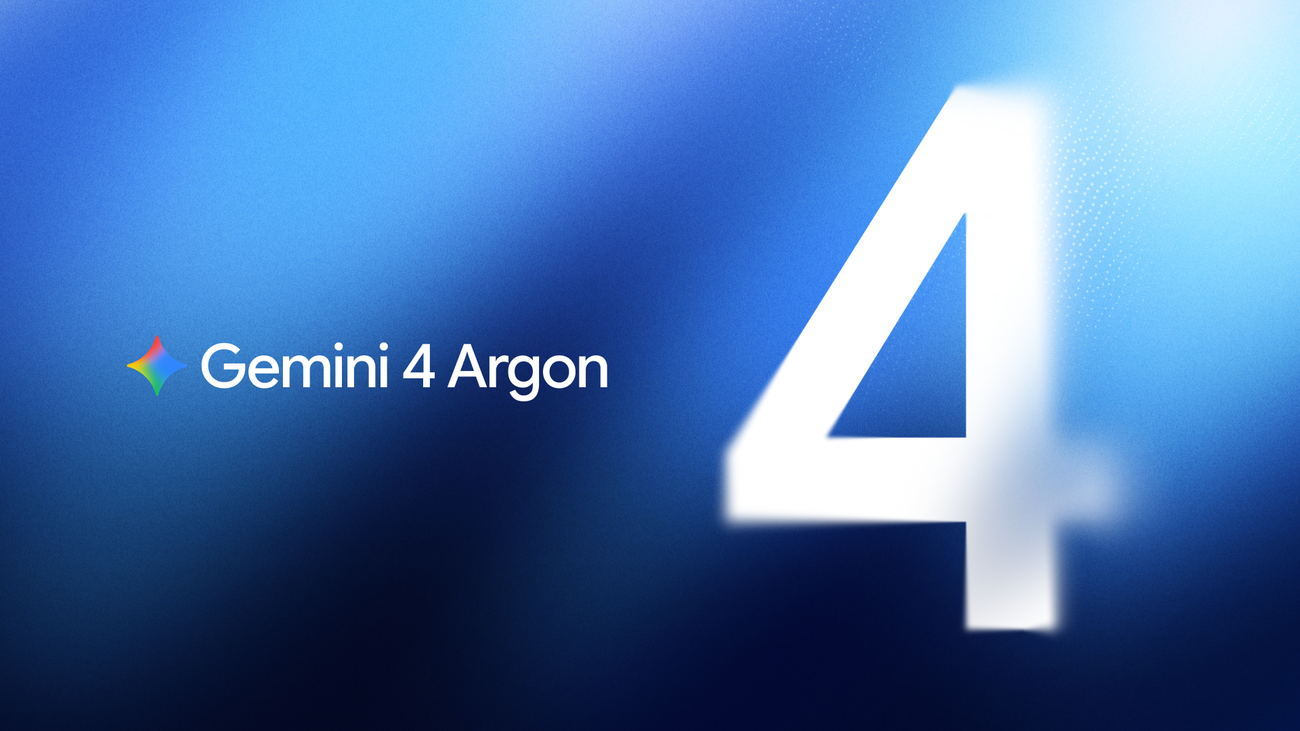

Gemini 4 Argon brings a 1 million-token output limit, stronger cybersecurity tools and aggressive pricing as Google tries to recover from months of model delays.
Gemini 4 Argon is Google’s new flagship artificial intelligence model, arriving after months of delays and the cancellation of its planned Gemini 3.5 Pro release.
Google introduced the model on September 30 and said it is designed for demanding software engineering, legal, financial and cybersecurity work.
According to Reuters, Argon is larger than Google’s previous top-tier Pro models and is being positioned against OpenAI’s Astra and Anthropic’s Opus.
For now, most users cannot access it.
Google is giving Gemini 4 Argon to a small group of trusted cybersecurity partners while it completes additional testing. The company has not announced a firm date for broad public availability.
Gemini 4 Argon arrives after Google’s delayed model reset
The launch follows a difficult period for Google’s flagship AI roadmap.
CEO Sundar Pichai had said Gemini 3.5 Pro would arrive in June. The model was delayed while Google worked to improve its capabilities, particularly in coding, and the company has now confirmed that it no longer plans to release it.
Reuters reported that the delay came during changes inside Google DeepMind and after several Gemini leaders left the company.


OpenAI and Anthropic continued releasing new frontier models during that period.
Gemini 4 Argon is Google’s answer to that gap.
Google describes the model as its strongest system for long and complex workflows. One of the most unusual specifications is its output limit.
The company says the model can produce up to 1 million output tokens during a single trajectory, compared with 64,000 previously.
That capacity is aimed at tasks where an agent may need to work through many stages without repeatedly restarting.
Google says the model is already being used internally for large code migrations, research and engineering tasks.
Benchmark results are strong but mixed
Google’s own results give Gemini 4 Argon strong scores across several professional evaluations.
In its official Gemini 4 announcement, Google reports a 77.9% score on DeepSWE v1.1, which measures performance on long software engineering tasks.
The company also says Argon ranks first on AutomationBench with a score of 51.3% and reached 91.7% on LVBench for long-video understanding.
Cybersecurity is one of the model’s main selling points.
Google says Gemini 4 Argon can autonomously find, validate and patch software vulnerabilities.
On CWE-bench v1, which measures a model’s ability to fix security flaws, Google reports a score of 68%, tied for first place.
Cloud security company Wiz is already testing Argon through its Scan for Good initiative. Google says the model identified a vulnerability affecting healthcare software that previous frontier models had missed.
Those results still require the usual benchmark caution.
Reuters reported that Gemini 4 Argon outperformed Astra and Opus on several self-reported measures but remained behind on two of the four coding benchmarks Google included.
Benchmark performance also does not guarantee that companies will get the same results on their own code, financial documents or legal workflows.
The AI Decode previously covered the Gemini 3 launch, which expanded Google’s multimodal reasoning and agent capabilities.
More recently, Google moved those systems closer to real-world action with Gemini Call for Me, which allows some Pixel users to let Gemini handle routine business calls.
Gemini 4 Argon pushes the same strategy deeper into professional work.
Cybersecurity capability is slowing the public rollout
The restricted launch is an important part of the announcement.
A model capable of discovering and fixing vulnerabilities can also possess information that could be useful for cyberattacks.
Google says it is strengthening protections against cyber misuse, chemical and biological threats, prompt injection attacks and unexpected agent behaviour before broad access begins.
The company is also participating in the U.S. government’s voluntary pre-release model access process.
Trusted cyber defenders will receive access that allows them to use more of Gemini 4 Argon’s cybersecurity capability. Broader users will face stronger restrictions.
Google also says it has built monitoring systems designed to detect when Argon’s reasoning or actions begin moving outside the user’s intended task.
That has become more important as frontier systems spend longer periods working independently.
Gemini 4 Argon also competes on price
Performance is only one part of Google’s pitch.
Gemini 4 Argon will launch at an introductory API price of $2 per million input tokens and $10 per million output tokens. Cached input tokens will receive a 95% discount.
After the introductory period, Google says pricing will rise to $4 per million input tokens and $20 per million output tokens.
That gives Google another way to compete with OpenAI and Anthropic.
Developers running large AI workloads care about benchmark scores, but they also care about how much each completed task costs.
A model that is slightly weaker on one benchmark can still make commercial sense if it delivers reliable results at a much lower operating price.
For Gemini 4 Argon, that makes pricing almost as important as raw capability.
Google says paid API customers and Google AI Ultra subscribers will be among the first broader groups to receive the model after the initial testing phase.
Until then, Gemini 4 Argon remains a flagship release with unusually powerful cyber capabilities, aggressive introductory pricing and one major unanswered question: how soon Google will be comfortable putting it into the hands of millions of regular users.